








Anima Mundi Herbals – a modern herbal apothecary with roots in the rainforest
|
|
Time to read 7 min






|
|
Time to read 7 min
When you discover Anima Mundi for the first time, you enter a world with a character all its own. Schisandra and reishi sit alongside rose petals, moringa, and pau d’arco. There are tinctures and teas, plant powders, essential oils, body oils, and handcrafted brass tea strainers.
Behind it is not a conventional supplement brand, but the idea of a modern herbal apothecary. It was founded by Adriana Ayales, a herbalist from Costa Rica who wanted to bring traditional plant knowledge into a form that also works in everyday life.
Anima Mundi achieves this in a way we still find quite unique.
Adriana Ayales grew up in Costa Rica. Plants and traditional herbal practices were part of her life from an early age; later, she explored herbalism, botany, and different healing systems in greater depth. She learned from herbalists and Indigenous teachers in Central and South America and studied, among other things, Western herbalism and Chinese plant medicine.
The fact that Anima Mundi ultimately came to be in Brooklyn was more unplanned than intentional. Adriana came to New York for a summer and never left.
She began making herbal extracts in her apartment and worked with personalized plant formulations. Her rooms filled with herbs from the rainforest, while friends helped with filling and packaging.
Individual formulations became recurring blends. The apartment became a rented kitchen, and the kitchen became an herbal laboratory.
This origin story remains remarkably fitting for Anima Mundi to this day.
The brand focuses less on individual trendy active ingredients and more on plants, formulations, and preparation methods. Some products are very simple, while others are complex. Some feel familiar, while others introduce plants you have probably never heard of before.
Adriana describes her work as the idea of connecting “ancient remedies” with the modern world.
That may sound a little grandiose at first. In everyday life, the idea is much more straightforward.
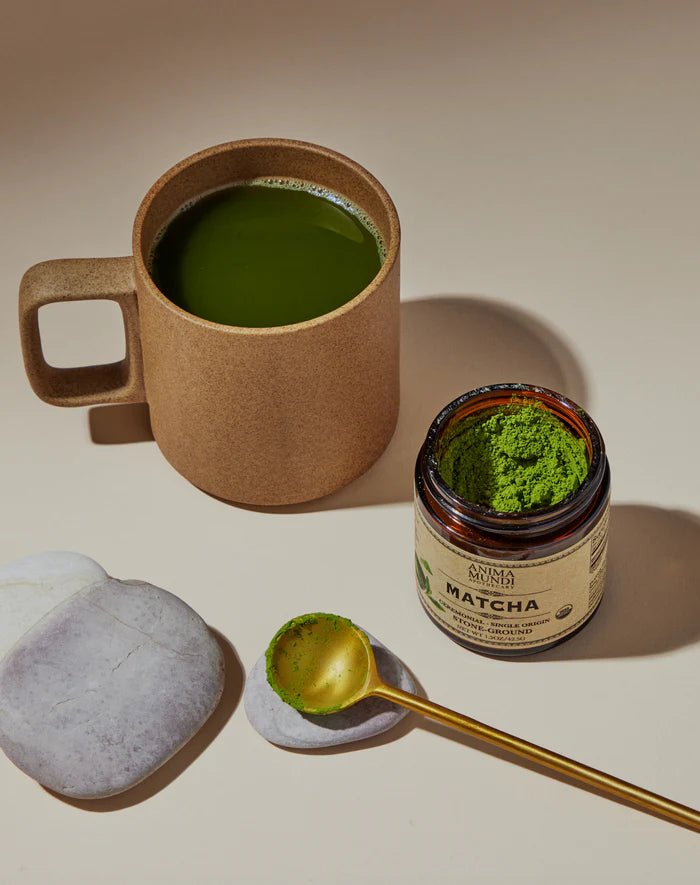
At Anima Mundi, a plant does not necessarily have to disappear into a capsule. Moringa goes into smoothies. Schisandra can be added to water or matcha. Reishi is stirred into cocoa. Rose petals are ground into powder. Herbs are brewed as loose-leaf tea.
In interviews, Adriana herself often talks about preferring to incorporate plants into food and drinks rather than taking a large number of supplements alongside one another.
Herbalism becomes a little less theoretical as a result. You smell the plant, taste it, learn its particular qualities, and eventually decide what actually fits into your own daily life.
At Anima Mundi Herbals, this ranges from highly accessible products such as rose powder or moringa to more complex herbal and mushroom formulations.
Anima Mundi’s roots clearly lie in Central and South America. Nevertheless, it would be wrong to reduce the brand to rainforest plants.
Over the course of her training, Adriana became familiar with various plant traditions and now brings them together. That is why Anima Mundi often features South American botanicals, Ayurveda, Chinese Daoist plant knowledge, and Western herbalism in the same range.
Suma and Pau d’Arco meet Reishi and Schisandra. Ashwagandha stands alongside nettle, lemon balm, or chamomile.
This could quickly seem arbitrary. At Anima Mundi, it works because the individual plants retain their identity. Schisandra does not need to be reinterpreted as the next superfood. Reishi is allowed to be Reishi. And a rose can sometimes simply be interesting because of its taste, fragrance, and centuries-old cultural significance.
Anyone who reads through the products will also notice how much knowledge is contained in seemingly small differences.
A mushroom is not simply “a medicinal mushroom.” Fruiting bodies, mycelium, and extracts are different things. An essential oil tells a different story about origin and distillation than a hydrosol does. And wild-harvested does not automatically mean the same thing as certified organic.
Anima Mundi awakens in us the desire to look more closely.
One of the terms that genuinely says something about the brand at Anima Mundi is Farm to Pharmacy.
Adriana places great value on direct relationships with small farms, wild harvesters, and producers. Some of the raw materials are certified organic, while others come from wild harvesting or sustainable cultivation.
That is an important difference.
A plant from a remote area of the Amazon does not necessarily have an organic certification. Anima Mundi openly explains that small producers or wild harvesters sometimes have neither the financial means nor the organizational access to obtain such certifications.
That is why the brand also considers origin, cultivation, harvesting, and collaboration with local people important.
This does not mean that certifications are unimportant. Rather, it means that quality in plants requires more questions than just one. Where does the plant grow? Who harvests it? Which part is used? How is it dried? How is it subsequently extracted?
This attention to detail can also be seen in the manufacturing process. Many formulations are developed and produced in the company’s own laboratory in New York. Depending on the formulation, liquid herbal extracts may infuse for weeks or months; ingredients include water, vegetable glycerin, organic sugarcane alcohol, and oils.
We originally came to know Anima Mundi primarily through tonics, adaptogens, and plant powders. In the meantime, we have found another part of the brand almost equally interesting: the connection between herbalism and external care.
The ROOT REVIVAL Hair Oil, for example, combines moringa and jojoba with nettle, horsetail, and rosemary. The ROSE Body Oil uses rose petals, plant oils, and herbal extracts. Rose water becomes a facial toner, while arnica and calendula become a rich balm.
Essential oils have also since become an integral part of the brand.
In 2023, Anima Mundi acquired Floracopeia, the essential-oil brand co-founded by David Crow. Over the course of decades, Crow had built relationships with small distilleries, farms, and eco-projects and had devoted himself to quality, adulteration, and the sustainable production of essential oils.
Today, Anima Mundi continues this work; David Crow supports the brand as Chief Aromatic Officer.
This explains why, with oils such as Palo Santo, Tulsi, or Rose Geranium, it is not only the scent that is interesting, but also the plant, origin, and method of distillation. You can find our selection under Essential Oils.
Of course, Adaptogens are also part of Anima Mundi.
Reishi, Schisandra, Maca, Ashwagandha, and other plants and fungi are often grouped under the term Adaptogens. In modern botanical practice, the term is used as a collective designation for various botanicals. However, the individual plants and fungi differ considerably in their origins, traditional uses, and characteristic plant-compound profiles.
We find their individual stories more interesting than the buzzword itself.
Maca is a root from the Andes and has long been a food there. Schisandra is a small berry from Chinese botanical medicine, known for its unusual interplay of different flavors. Reishi, known as Ling Zhi, has a centuries-old history in East Asia.
Anyone who categorizes everything simply as “Adaptogens” misses an important part of the picture.
That is why, in our product descriptions, we prefer to explain where a plant comes from, the role it has traditionally played, and what the formulation actually contains.
The American brand sometimes speaks very openly of Healing, Detox, Hormone Balance, Brain Tonics, or Immune Support. European food law places significantly stricter limits on health-related claims.
And regardless of legal requirements, we also find the distinction important in substance:
Traditional use, modern research, and proven efficacy are not always the same thing.
A plant can have a fascinating centuries-old history without every traditional use being scientifically proven. Conversely, a promising laboratory study does not make an herbal tea a medicine.
Unusual international botanicals raise another issue: not every plant or extract form offered in the United States is automatically approved for sale as a food in Europe.
That is why we continually review formulations and product information at Blanda and do not necessarily carry every product available in the American Anima Mundi range.
For us, this care does not contradict our enthusiasm for traditional botanical knowledge. It is part of it.
After all these years with Anima Mundi, it is not the big promises that interest us about the brand.
It is more this combination of curiosity, plant knowledge, and a certain nonconformity.
Anima Mundi can inspire you to try Schisandra for the first time. To read about why Palo Santo develops its characteristic scent only after years of natural aging. To understand the difference between rose hydrosol and essential oil. Or to find a cup of loose-leaf herbal tea more interesting again than the next functional drink in a can.
You don't need all of it. Not every plant suits every person.
But much of it sparks curiosity.
Anima Mundi doesn't simply sell high-quality products. It opens a door to a world of plants, of which one previously knew only a small part.
Anima Mundi was founded by Costa Rican herbalist Adriana Ayales. The brand emerged in Brooklyn from her work with traditional plant formulations and continues to be shaped by her as an herbalist and founder.
The raw materials come from different regions of the world. According to its own information, Anima Mundi works with small farms, wild harvesters, and producers, distinguishing between organically certified, wild-harvested, and sustainably cultivated plants.
For us, it is the combination of traditional plant knowledge, unusual botanicals, comparatively original formulations, and a form of use that can be easily integrated into everyday life - as tea, powder, tonic, oil, or plant care.
No. Many raw materials are organically certified, while others come from wild harvesting or sustainable cultivation. We state the respective quality and origin as specifically as possible on the product pages.
The range from the US brand cannot automatically be transferred in full to the European market. We review the composition and marketability in Germany and the EU, particularly for unusual plants and extracts.


