






What are skin scents? Why skin-close perfumes are so popular right now
|
|
Time to read 11 min







|
|
Time to read 11 min
Not every fragrance needs to fill a room. Some perfumes are at their most beautiful when you come a little closer to them.
Skin Scents are among the most exciting developments in the modern fragrance world. They stay closer to the skin, feel soft and intimate, and sometimes almost seem as though your own skin simply smells exceptionally good. Instead of a large cloud of fragrance, they create a personal aura—noticeable, but not overpowering.
At first, this sounds like a very subtle perfume. In fact, there is more to it. Skin Scents deliberately play with body heat, skin, perception, and fragrance ingredients such as musk, ambrette, Ambroxan, or Iso E Super. That is why they can develop in remarkably individual ways.
So what makes a Skin Scent? Why are these fragrances so popular right now? And do they actually smell different on the skin than other perfumes?
Skin Scent literally means simply “skin fragrance.” However, it does not refer to a clearly defined fragrance family such as floral, woody, or gourmand.
Skin Scent describes more the effect of a perfume.
These fragrances usually stay relatively close to the body and feel less like an additional layer of perfume than like an extension of your own skin. They can smell warm, creamy, powdery, clean, woody, salty, or slightly animalic. Musk, ambrette, Ambroxan, Iso E Super, sandalwood, iris, and soft cashmere and wood notes are common.
What matters is its proximity.
A classic perfume can leave a distinct trail and be noticed before someone is standing directly beside you. A Skin Scent narrows the radius. Sometimes you only smell it with a movement, while putting on a sweater, or when bringing your wrist to your face.
And sometimes someone else only notices it when they come closer to you.
Perhaps that is precisely the appeal: A Skin Scent is not a fragrance for the whole room. It is more like a little secret between you and your skin.
The idea itself is not entirely new. Musk fragrances, perfume oils, and later minimalist molecular perfumes have long explored the concept of a scent that works less through projection than through proximity.
What is new is how naturally this aesthetic has now found its place in modern perfumery.
After years of very sweet gourmand fragrances, high fragrance concentrations, and maximum projection, the desire for the opposite is growing: perfumes that don’t immediately smell like perfume. That don’t enter the room before their wearer does. And that feel more personal.
Internationally, this trend is often described using terms such as “second skin,” “your skin but better,” or “quiet luxury.”
It is less about restraint at all costs than about a different kind of presence. The fragrance should not disappear. It should come closer.
And that fits with a generally more individual way of wearing perfume. Not everyone today is looking for one grand signature fragrance for every occasion. Fragrances are selected, combined, and layered according to mood, time of day, and situation.
A Skin Scent works much like a very personal piece of clothing: You wear it primarily for yourself.
Anyone who primarily associates perfume with strong sillage and as many compliments as possible may initially find some Skin Scents difficult to appreciate.
Their strength lies elsewhere.
They are wonderfully easy to wear in everyday life, work in the office, while traveling, or in situations where a room-filling perfume can quickly become too much.
At the same time, good Skin Scents have something remarkably sensual about them. Precisely because they do not reveal everything from a distance, they create closeness.
There is also an interesting effect: You often do not perceive skin-close fragrances continuously. They appear, disappear, and suddenly return. As a result, they can feel less tiring than a fragrance that remains constantly present for many hours.
Skin Scents are also wonderful layering partners. A soft musk, Ambroxan, or transparent woody fragrance can sit beneath a floral, spicy, or fruity perfume and give it more warmth and body without overshadowing the original idea.
And last but not least, many of these fragrances feel remarkably personal.
They smell less like a finished fragrance idea and more like you—just a little better.
Yes. However, the explanation is a little more interesting than the often-cited “perfume reacts with your skin’s pH.”
In general, every perfume develops differently on skin than on a paper strip. Skin is warm, contains moisture and lipids, and is not a neutral surface. Fragrance molecules therefore do not all evaporate at the same rate.
There are also differences from person to person.
Recent studies show that factors including skin moisture, transepidermal water loss, and the condition of the skin’s surface can influence how individual fragrance ingredients are released. The frequently mentioned pH level is only one of several possible factors.
So the much-quoted “skin chemistry” does indeed exist—just not quite in the way it is sometimes portrayed.
A perfume does not suddenly transform into a completely different fragrance on the skin. What matters instead is which components evaporate more quickly, which remain on the skin longer, and the proportions in which we perceive them as a result.
And perhaps that is the real magic.
With an opulent fragrance containing many powerful notes, these subtle differences are less noticeable. A transparent skin scent, by contrast, gives the skin more room. As a result, the same composition may smell drier and woodier on one person, and creamier, warmer, or slightly sweet on another.
That is why skin scents should always be tested on your own skin.
That is one of the most interesting peculiarities of the fragrance world.
Firstly, our noses become accustomed to smells to which they are exposed for longer periods. This process is known as olfactory adaptation. The perfume may therefore still be present even though you yourself barely notice it anymore.
Secondly, individual fragrance molecules are perceived with varying intensity by different people.
With musk in particular, it has now been well established that genetic differences in our olfactory receptors can influence how intensely certain musk molecules smell.
That is why it can genuinely happen that you can barely smell a fragrance anymore while someone next to you can smell it clearly.
Molecular fragrances in particular are known for this almost ghostly effect: The fragrance seems to have disappeared, then reappears later.
When you move. Through body heat. On a scarf. Or suddenly again on your wrist.
A skin scent can therefore seem more lively than a fragrance that remains equally present from morning to night.
This is where an important distinction is useful.
Projection describes how far from the skin a fragrance can still be perceived.
Longevity, by contrast, describes how long it remains perceptible at all.
The two are not the same.
A skin scent may project only a few centimeters beyond the skin and still last for many hours.
Molecules such as Ambroxan, Iso E Super, Cashmeran, and various musk notes can be remarkably long-lasting. For Iso E Super, for example, the fragrance manufacturer IFF states a so-called substantivity of more than 48 hours.
A subtle fragrance does not necessarily fade quickly. It may simply have decided to stay with you.
There is no fixed list of ingredients. However, some raw materials and aroma molecules appear particularly often.
Musk is probably one of the most important building blocks of this fragrance world.
Modern musk notes can seem clean and soft, powdery, creamy, or slightly animalic. They often evoke not so much a specific fragrance note as warm, well-groomed skin.
This elusive quality is what makes musk so interesting for skin scents.
Ambrette is obtained from the seeds of musk mallow and is one of the most beautiful plant-based ways to give a fragrance a musky warmth.
It can seem soft, slightly fruity, nutty, and powdery while also having something airy about it. Ambrette rarely smells dominant. Rather, it settles among other notes and can give them a warm, almost bodily quality.
Ambroxan is one of the characteristic molecules of modern perfumery.
It moves somewhere between amber, dry wood, warm skin, minerality, and a slightly salty freshness.
The exciting thing about it is that Ambroxan can be clearly noticeable without smelling particularly “perfumed.”
This creates an aura that characterizes many modern skin scents.
Iso E Super is also closely connected with the development of modern molecular and skin scents.
The molecule is described as soft, woody, and ambery, with an almost velvety effect. In a composition, it can add volume without taking center stage like a classic, clearly recognizable fragrance note.
That is why Iso E Super sometimes feels more like a texture than a specific smell.
Sandalwood brings warmth, creaminess, and smoothness. Cashmere notes and Cashmeran can also create something soft, dry, and almost fabric-like.
The result is less reminiscent of freshly cut wood than of warmth on the skin—a soft sweater, sun-warmed fabric, or a smooth wooden surface.
Skin scents are not just about smell. The very best examples have an almost tactile quality.
No.
“Skin scent” and “clean scent” are often treated as synonyms, but they are not the same.
A skin scent can smell like freshly washed skin and white musk. But it can just as easily be balsamic, woody, spicy, floral, lightly gourmand, or even animalic.
What matters is not the fragrance family, but the way the scent wears.
A warm sandalwood fragrance can be a skin scent. A transparent amber can be one too. Even a slightly leathery or resinous composition can have this close-to-the-skin effect if it clings closely to the body and does not create a large scent cloud.
This makes the category much more varied than the term might initially suggest.
The terms overlap, but they do not mean the same thing.
A molecular perfume places individual modern fragrance molecules or a highly reduced composition particularly at the forefront.
Skin scent, on the other hand, describes how a fragrance performs on the skin.
Many molecular perfumes are also excellent skin scents because materials such as ambroxan, Iso E Super, or certain musk notes can create precisely this transparent, close-to-the-body quality.
However, a skin scent can just as well consist of a more complex blend of natural and modern fragrance materials.
Learn more about this topic in our guide Molecular Perfumes: A New Era of Fragrance Creation.
With hardly any other type of fragrance is a test strip so uninformative as it is here.
Spray the fragrance on your skin and leave it alone at first. Do not decide immediately.
The more interesting phase often only begins after 20 or 30 minutes. Ideally, wear the fragrance for several hours. Notice when you perceive it, how it changes with movement, and what remains on the skin in the end.
It is best not to test several skin scents at the same time on both arms. With musk and molecular fragrances in particular, your nose can quickly lose track.
That is why we also offer all our niche perfumes as hand-filled 1.2-ml samples. This allows you to get to know a fragrance over several hours and on different days on your own skin—especially with skin scents, it is a much better way to find a favorite.
Skin scents can be very different. These five fragrances beautifully demonstrate how broad the spectrum can be between musk, ambrette, ambroxan, transparent woods, and warm skin.
AMBR SUPER by Son Venïn is a wonderful introduction to this fragrance world.
Cardamom, plum, and ambrette meet ambrox, tonka bean, and warm woods. AMBR SUPER is soft, ambery, and close to the skin, while still possessing enough warmth and character not to simply disappear into the background.
Warm, velvety, and close to the skin.
Studied by Liis shows the light, powdery side of the skin-scent theme.
Pear and ambrette meet carrot seed and orris; Ambroxan and cashmere create a warm, soft base.
Modern, calm, and very refined – almost like a light veil on the skin.
Quelque Part by Racyne combines ambrette, fir balsam, Cashmeran, vetiver, and vanilla into a creamy, balsamic warmth with gentle green and woody depth.
A beautiful example that close to the skin doesn’t automatically mean clean or minimalist.
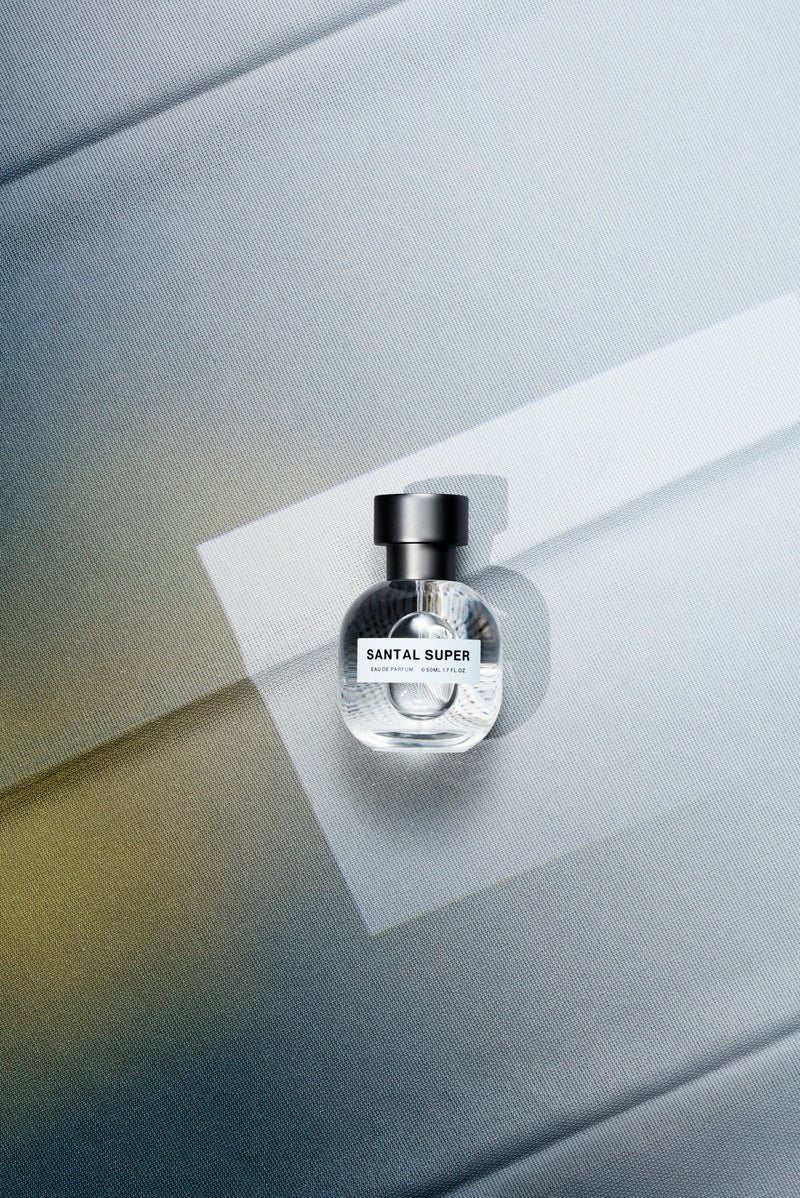
SANTAL SUPER by Son Venïn interprets sandalwood with surprising transparency.
Pepper, cardamom, jasmine, and incense meet sandalwood, cedarwood, white musk, and Iso E Super.
Dry, warm, spicy, and soft. A fragrance that doesn’t constantly ask for attention and remains interesting because of it.
Doppelgänger by Heretic Parfum is perhaps the most unusual interpretation.
Cool citrus notes, soft florals, light woods, and diffuse musk notes appear, disappear, and return.
Doppelgänger feels almost like a second, slightly shifted version of your own skin – abstract, close to the body, and difficult to fully pin down.
Anyone who would like to compare this fragrance world directly will find five skin scents in our Molecule Mood Parfum Discovery Set.
From powdery ambrette and transparent woods to Iso E Super, Ambroxan, Cashmeran, and soft musk, the set beautifully shows how different a skin scent can be.
And above all, this lets you try out exactly what these fragrances are really about:
How do they smell on my skin?
That’s where the special appeal of skin scents lies.
They don’t necessarily want to stand out. They don’t need to make a grand entrance or leave a scent trail the moment they enter a room.
They stay closer.
Sometimes warm and creamy, sometimes dry or powdery, sometimes so abstract that you can’t quite say exactly what you’re smelling.
And at some point, the line between skin and perfume is no longer entirely clear.
That’s why a skin scent is less of a statement than a personal scent trail.
Because in the end, a perfume doesn’t have to fill the entire room. Sometimes it’s enough if it smells just a little like you.


